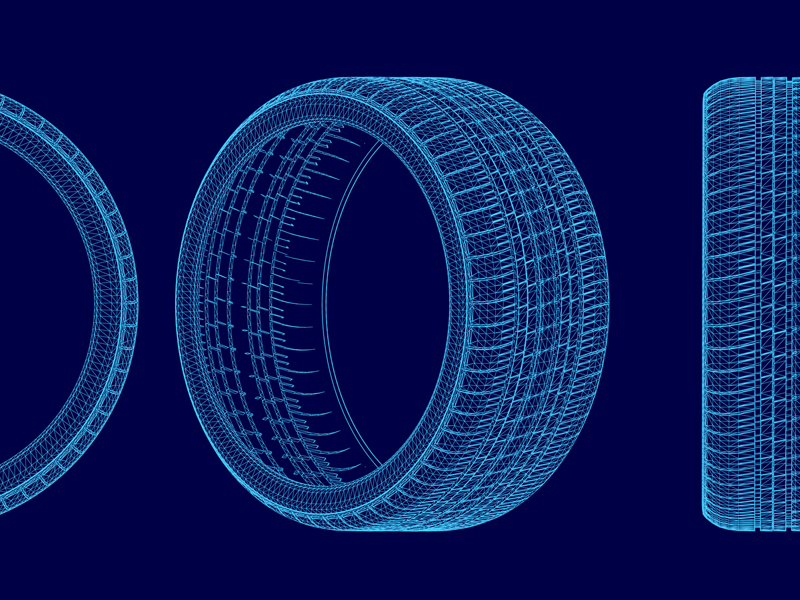
In modern vehicle development, the tire is no longer just a rubber component—it is a sophisticated "translator" of forces. As the only physical link between a vehicle and the road, every acceleration, braking maneuver, and steering input is filtered through its complex, non-linear, and viscoelastic structure. For Tire Engineers and Product Leaders, the challenge lies in capturing this physical behavior and converting it into a high-fidelity digital twin.
To help demystify this transition, we spoke to Tire & Wheel Test Lab Technical Director Cliff Hodges to explore how strategic engineering can move development beyond the "standard request" and toward high-fidelity simulation that accurately predicts real-world behavior.
Why is the tire often called the "Black Box" of vehicle dynamics and how can this impact tire models?
The tire is the only non-linear, viscoelastic component connecting a vehicle to the road, making it the primary means of communication between the two. Despite its importance, the tire remains the least understood variable in many digital models.
A quality tire model therefore turns accurate physical sensor readings into a "digital twin" that can predict performance across a variety of conditions. If a team asks for a tire model without defining the specific use case, they often end up with a high-fidelity model they can't run, or a low-fidelity version that misses critical real-world behaviors.
How should teams determine the right level of model complexity?
You must match the fidelity to your objective. Typically, the hierarchy of complexity falls within three models or elements:
- Handling Models: Pacejka’s Magic Formula (MF) is excellent for steady-state and transient Force & Moment (F&M) analysis. It’s an empirical model, meaning it adjusts coefficients to fit raw data rather than representing the physical structure.
- Ride and Comfort Models: These require a physical approach, such as FTire or CDTire. In these models, the equations represent the actual physical components of the tire's structure. They are the superior choice for simulating durability events, such as hitting curbs or potholes.
- Finite Element Analysis (FEA): FEA provides immense detail regarding small elemental physics and is usually built from CAD designs rather than test data. However, it is slow; an event that takes an FTire model 10 seconds to process might take an FEA model up to an hour to render.
How do we properly decode the testing matrix to ensure the tire model captures the full operational envelope?
Building an accurate tire model requires moving beyond a simple checklist and into a deep understanding of the tire's "Operational Envelope." This phase is dedicated to mapping out how the tire will behave under specific stress conditions. Engineers must account for several critical factors to decode this matrix effectively:
- Thermal Sensitivity Management: Designing a test requires a deep understanding of the tire's optimal temperature window. High-performance tires operate at significantly higher temperatures than winter or all-season variants. To remove hidden variables, every measurement condition should ideally begin at the same thermal state. This requires warming the tire sufficiently before measuring, while ensuring it doesn't cool down and fall out of its peak window during the sequence.
- Vertical Load Sensitivity (Fz): Tires are inherently non-linear because of their complex rubber composition. The point where a tire shifts from linear to non-linear behavior is typically proportional to its designed Load Index (LI). For physical models like FTire and CDTire, it is essential to measure these non-linearities to identify structural limits and understand the impact of pushing the tire beyond its intended load.
- Slip (SA) and Camber (IA) Synergy: Accurate modeling must account for how alignment angles and cornering forces interact. This synergy can significantly alter the lateral force curve and increase rolling resistance (RR).
- Inflation Pressure Sensitivity: There is a growing demand to model how minute changes in inflation pressure affect performance. This is particularly relevant for the modern generation of high-mass Electric Vehicles (EVs), where small pressure deviations can have an outsized impact on vehicle dynamics.
By meticulously defining these boundary conditions—including loads, cambers, and pressures—the testing plan ensures the resulting model isn't just a collection of data, but a high-fidelity digital twin capable of predicting real-world performance.
Is there a way to help clients bridge the "knowledge gap" between a vehicle’s intended use and the digital tire model?
To build a high-fidelity digital twin, clients must first possess a fundamental understanding of their vehicle's Operational Driving Domain (ODD) and its full range of operation. While this data can be difficult to pinpoint early in development, using basic vehicle modeling and early-stage simulations can help define these requirements.
To ensure the model is robust, the testing phase must bridge several technical gaps:
- Defining the Operational Envelope: Testing conditions must mirror the real-world boundary conditions of the vehicle, including specific loads, pressures, and camber angles.
- Mitigating Extrapolation Risks: Predictive confidence is highest within the original parameters of the physical test. Once the simulation moves into extrapolated cases, confidence decreases. To prevent formulas from "breaking" during a simulation, the physical testing must push the boundaries of the original parameters. Some software suites like FTire provide simulation environments where different conditions, not used in the parameterization process, can validate the models predictions – even before moving to vehicle simulation stages.
- Capturing Combined Slip: Accurate "Limit-Handling" requires moving beyond pure braking or pure cornering data. The model needs data from scenarios where the tire is performing both actions simultaneously to reflect true vehicle dynamics.
- Addressing the "Zero Velocity" Nuance: Often called "parking torque" or "turnslip," this captures how a tire behaves during transient, low-speed maneuvers. While many models focus on steady-state driving, specialized plugins are necessary to predict this behavior, which remains critical from parking lot speeds to highway travel.
How do we transition a tire model from a laboratory to software applications, accounting for differences in each environment?
The final phase of tire modeling involves translating lab-grown data into a functional tool for simulation software. This stage—Practical Integration—is where the digital twin is calibrated for the road and formatted for industry-standard toolsets. The standard testing indoors is on sandpaper rather than asphalt. Therefore, friction coefficient scaling must be involved. It’s a common challenge for all modeling users and is multi variable. Surface temperature, ambient temperature, precipitation/moisture, and aggregate composition all play pivotal roles in the surfaces’ coefficient of friction. Once a tire model and vehicle simulations have been completed, one can compare those results to outdoor vehicle data to evaluate the friction comparisons. When achieved on a calibrated outdoor surface (test track generally), the models from there on can be scaled accordingly.
The industry standard deliverable is a .tir file, a text file containing all parameters for the simulation environment. Most commercial platforms accept this, though some also accept basic friction models that must be defined specifically within the ecosystem.
Accuracy by Design
The most impactful tire models aren't simply off-the-shelf commodities; they are the result of a deliberate "Intake Phase" where the testing lab and the product team co-author the tire's operational envelope.
This collaborative foundation transforms high-fidelity modeling from a data-gathering exercise into a strategic asset.
By prioritizing this digital-first approach, organizations can drastically minimize physical prototyping expenses and compress development timelines. Ultimately, this precision ensures that "driver-in-the-loop" simulations provide the authentic, tactile experience required by test drivers to make critical decisions long before a physical vehicle ever hits the track.
If you’re ready to bridge the gap between physics and the digital twin, connect with Cliff Hodges at Smithers to begin defining your vehicle’s operational envelope. Our team is ready to help you build the high-fidelity models necessary to move your program into the virtual fast lane.