Inkjet printing has become one of the most consequential technologies in global manufacturing and communications, with the combined graphic, packaging, industrial and functional market valued at over $130 billion in 2026. Its influence now extends across packaging, publishing, commercial print and industrial decoration. With the graphics and packaging sector alone
forecast to reach $134.6 billion by 2031, the technology is reshaping the economics and capabilities of print at scale. We explore five of the key structural trends driving that shift.
1. Asia Becomes the Engine of Global Growth
For decades, North America has set the pace for inkjet adoption. It was the largest geographic print output market in 2021, commanding 35.6% of global inkjet volume. By 2026, Asia Pacific draws level, and by 2031, it leads on every metric. China and India are the principal drivers, reflecting both countries’ status as global manufacturing and economic powerhouses.
Crucially, this is not simply a story of imported Western technology finding new customers. Asian manufacturers are developing their own hardware and ink platforms, with China and India increasingly important for printer production, and Western equipment makers are beginning to feel competitive pressure as a result.
2. Strong Growth in Packaging & Labels and Industrial Print
Advertising print remains the largest single end-use segment for inkjet today, but growth is slowing, due to falling direct mail volumes and softness in sign and display. Transactional printing faces a similar trajectory. Packaging represents the most significant growth opportunity in inkjet, with both volume and value expanding faster than any other end-use application as the market transitions from analogue to digital. Despite this momentum, penetration rates remain modest, and the path to mainstream adoption in packaging will require sustained technological and commercial progress.
Meanwhile in the industrial and functional markets, all end-use segments are growing strongly. The electronics segment is the highest value segment, although it is highly fragmented. The inkjet textile business has seen strong growth and this trend will continue.
3. Sustainability Reshapes Ink Formulation
The ink market, currently valued at $9.9 billion and forecast to reach $13.3 billion by 2031, is undergoing a significant transformation. Water-based inks are gaining ground across virtually every segment. Already the standard in textile, corrugated, commercial and book printing, they are now advancing rapidly into packaging applications, where food-contact migration regulations, recyclability requirements and safe-handling concerns are creating compelling incentives to move away from solvent-based alternatives.
Radiation-cured technology is also an important and fast-growing technology for inkjet in advertising, commercial printing and labels. There is a notable transition underway from conventional UV to LED-UV, which offers lower energy consumption and reduced heat output, a meaningful benefit when printing on heat-sensitive substrates. Despite these advantages, there are challenges in terms of indirect food contact compliance, which limits growth of this technology in packaging.
4. The Rise of Purpose-Built Machines
The era of the general purpose inkjet press is giving way to a new generation of highly optimised, application-specific machines. Equipment developers are increasingly designing presses that balance print quality, speed and cost for a precisely defined use case, whether that is narrow-web label production, high-speed corrugated printing, or digital textile decoration.
This trend is reinforced by a parallel move among leading manufacturers to develop and control proprietary print head technology. HP, Epson, Konica Minolta, Ricoh, Kodak and now Canon and Domino (via Brother) all produce their own heads, giving them tighter control over system performance and total cost of ownership.
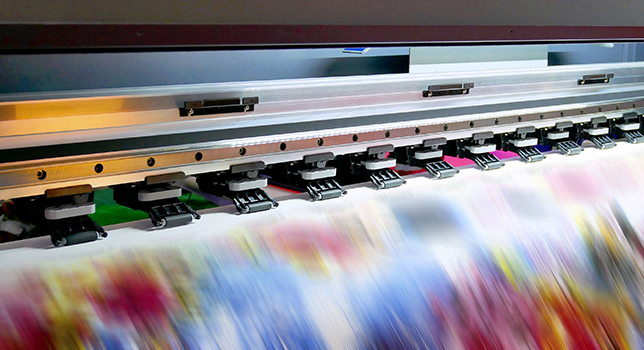
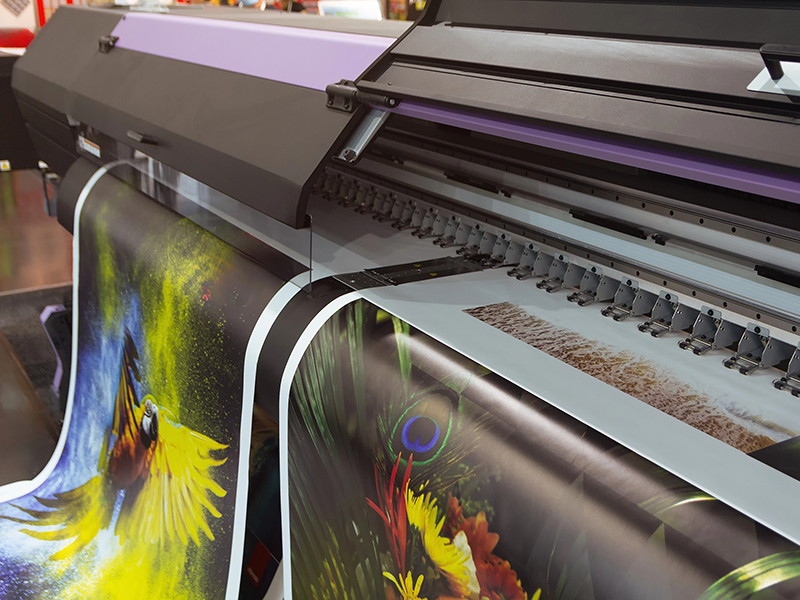
The practical consequence is visible in the wide-format graphics market, where multiple older, slower machines are being replaced by fewer, higher-output machines in single-pass or hybrid roll-to-roll/sheetfed format.
5. AI and Automation Redefine Operational Economics
Total cost of ownership has historically been a significant barrier to wider inkjet adoption. Ink costs, rapid technology obsolescence and the complexity of managing a mixed fleet of devices have kept the economics of digital production above those of established analogue alternatives.
AI and automation are closing that gap: predictive maintenance and AI-driven diagnostics are extending press uptime and reducing costly unplanned stoppages; while inline inspection systems ensure high quality and reduce waste. Fleet management software is optimising job scheduling and resource allocation across multiple devices simultaneously.
By 2031, these capabilities are expected to be standard across the inkjet installed base, as older, less automated machines are phased out. The implication for print businesses is that operational excellence, enabled by digital intelligence, will increasingly determine competitive position, irrespective of the substrate or application.
Conclusion
Inkjet printing is no longer a challenger technology. The combined effect of supply chain realignment, evolving print procurement models and continuous technology development has positioned inkjet at the forefront of innovation and commercial growth across the global print market. The
latest research from Smithers suggests that its most disruptive phase may still lie ahead.
This article is based on the findings of a newly published report, The Future of Inkjet Printing to 2031
. This comprehensive new study delivers the granular segmentation, regional breakdowns, and forward-looking forecasts needed to make confident, informed decisions in a fast-moving market.