
The Future of Printer Demographics to 2031
Explore the global printing industry outlook to 2031: production printer volumes, competitive landscape, and strategic scenarios across key geographies and segments.
New research from Smithers, the global authority on the printing industry, finds that the printing and allied industries sector contracted sharply between 2019 and 2024. According to its latest report, The Future of Printer Demographics to 2031, establishment numbers fell to 353,707 in 2024, down 7.9% from 384,102 in 2019, while employment dropped 12.7% to 3.4 million from 3.9 million over the same period.
Falling demand for physical print, geopolitical disruption and structural shifts in end-use markets are driving the decline, which has affected all regions. The report points to five trends shaping the industry’s trajectory to 2031.
End-use demand continues to soften. Publication and graphic printing remain the hardest hit, with newspapers, magazines and advertising print seeing the steepest declines as content moves online. Book printing and select industrial applications have proven more resilient. Packaging and labels continue to post solid growth, although these segments are excluded from the trade and employee data in the report. By 2031, traditional print categories are expected to keep declining, but at a slower rate, with some publications surviving as niche products.
Asia’s share of the industry is growing. The region already accounts for 41.9% of global establishments, up from 40.5% in 2018, and 55.4% of employees, a modest increase since 2019. This reflects a slower rate of decline than other regions, supported by population growth, a strong domestic market and substantial export activity. The report points to Latin America and Eastern Europe as seeing the steepest percentage falls in establishment numbers, while North America has recorded the largest drop in employee numbers.
Automation is reshaping the workforce. The study shows press manufacturers introducing automation across most equipment lines to offset skill and staffing shortages. This shift has itself reduced establishment numbers, as newer, higher-output presses replace multiple older machines. By 2031, high-productivity presses are expected to be the norm, with automation helping to close the industry’s skills gap. Downward pressure on employee numbers is set to continue.
Sustainability pressures and recruitment challenges persist. The research finds that physical print faces ongoing scrutiny over its environmental impact, but this is balanced by its recognised effectiveness as a medium and by growing concern over the energy footprint of digital infrastructure. At the same time, the industry continues to struggle with attracting and retaining skilled operators, held back by the perception of printing as an unattractive career and its limited compatibility with remote work. This pressure is expected to ease as training programmes expand and automation lowers the skills barrier.
AI adoption is advancing, cautiously. By 2031, Smithers expects AI practices to become more established and reliable, benefiting physical print – particularly in content distribution – as trust in the medium grows.
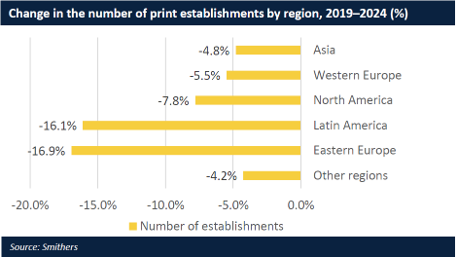
Source: The Future of Printer Demographics to 2031, Smithers
The Future of Printer Demographics to 2031 provides comprehensive data and forecasts on establishment numbers, employee trends, productivity, regional dynamics, and the competitive forces reshaping the global printing sector.
The report is available to purchase now from Smithers priced $6,750 (€6.350, £5,475).